Managers need to be capable of making unbiased, solid decisions that benefit their companies. There are two types of decisions: ones that need to be made on the spot and ones that require more time because their outcome has higher consequences upon a business. Oftentimes, the speedier decisions are made upon intuition- or at least recognizing a problem, relating it to a past problem and thinking back on how it was solved in the past. Of course, for more important decisions, this should not be the end of the decision-making process. From this point, a manager should reflect on how a past decision has affected a company and if there are any other alternative actions that could be taken. The goal being to make the best possible decision, not just any decision.
In the article I read, the author offers this advice "Leaders should not rely solely on intuitive judgments, nor on painstaking analyses. The key is to know how to choose. The more complex the decision, the more leaders need to supplement their hunches with investigation and analysis. But realizing that the brain is a maestro at recognizing patterns reminds them to respect their intuition as well."
Oftentimes we end up being guided by past experiences without being conscience of it. For example, in life, people often end up dating the same type of people and end up disappointed time and time again if their type is not 'good'. People buy the same type of products overtime too. When your sick, you automatically grab soup for dinner, instead of considering that bread may actually make your stomach feel better. It is important to train your mind to stop automatically going for the normal or comfortable. Yes, use your intuition to guide you, but don't let it be your ultimate solution because then nothing will ever change for the better (in your life or in a business).
Source:
Callahan, Lisa. "Blink or Think?." T+D 64.2 (2010): 68-69. Academic Search Complete. EBSCO. Web. 28 Mar. 2010.
Sunday, March 28, 2010

Nominal Group Technique
Chapter 12 discussed individual and group decision making. When a certain group of people has to come up with a decision, it would be no surprise that we would all assume chaos. To be able to come to a group consensus and to be able to come up with ideas and decisions well, a form of structure is needed. This is where the nominal group technique comes in. The Nominal Group Technique is a decision making process used in a group setting. There is a particular process that needs to be done when using this technique:
1) Understanding the problem
2) Everyone in the group offers ideas to help solve the problem
3) Everyone discusses the ideas and decided whether or not they agree. This is the time they also ask for people’s clarifications.
4) Everyone votes anonymously for their choices
According to research done by Ann McPhail, this technique can also be useful for students. She did a study on how it affected students’ opinions about physical education in their school. The school was having a difficult time with trying to gather the students’ opinions about exercising and what they should do for physical education. The researcher noted, “The quantitative data (rankings) from the NGT format allows the researchers to assess the strength that the statements (qualitative data) had in the pupils’ response to a specific research question. “ In other words, it gave more details about the students’ response. It surprised me how a nominal group technique can be beneficial in a class setting.
Source:
MacPhail, A. (2001). Nominal Group Technique: A Useful Method for Working with Young People. British Educational Research Journal , 161-170.
1) Understanding the problem
2) Everyone in the group offers ideas to help solve the problem
3) Everyone discusses the ideas and decided whether or not they agree. This is the time they also ask for people’s clarifications.
4) Everyone votes anonymously for their choices
According to research done by Ann McPhail, this technique can also be useful for students. She did a study on how it affected students’ opinions about physical education in their school. The school was having a difficult time with trying to gather the students’ opinions about exercising and what they should do for physical education. The researcher noted, “The quantitative data (rankings) from the NGT format allows the researchers to assess the strength that the statements (qualitative data) had in the pupils’ response to a specific research question. “ In other words, it gave more details about the students’ response. It surprised me how a nominal group technique can be beneficial in a class setting.
Source:
MacPhail, A. (2001). Nominal Group Technique: A Useful Method for Working with Young People. British Educational Research Journal , 161-170.
Saturday, March 27, 2010
Chapter 12
Simon’s Normative Model is a model, guided by bounded rationality, of processes that managers use when making decisions. Bounded rationality means that the decision makers have certain restrictions that affect their decision, such as, personal or environmental characteristics that lower rational decision making. This restriction results in minimal solutions to problems as opposed to optimal solutions, making it difficult for alternative solutions to be identified in the long run. Thus, decision makers are forced to satisfice with minimal solutions. An example of this would be when I received an assignment to compute a company’s financial ratios. The teacher left out the part where he wanted us to compare the ratios to the industry ratios and what the industry’s normal ratios were, therefore this lack of information created the restriction for my classmates and me. We had to satisfice by just computing the ratios and presenting the numbers, however, the numbers meant nothing without a comparison. As a result, my class handed in papers that only met the minimum and not the full requirements of the assignment.
In Power’s (2005) website, Simon claims that rational humans are satisficer and not optimizers by nature. According to Herbert Simon:
“The social sciences suffer from acute schizophrenia in their treatment of rationality. At one extreme, the economists attribute to economic man a preposterously omniscient rationality. Economic man has a complete and consistent system of preferences that allows him always to choose among the alternatives open to him; he is always completely aware of what these alternatives are; there are no limits on the complexity of the computations he can perform in order to determine what alternatives are best; probability calculations are neither frightening nor mysterious to him ... At the other extreme, are those tendencies in social psychology traceable to Freud that try to reduce all cognition to affect. Thus we show that coins look larger to poor children than to rich, that pressures of a social group can persuade a man he sees spots that are not there, that the process of group problem-solving involves accumulating and discharging tensions, and so on.”
This means that social sciences suffer from rationality because it constricts us to only think one way and therefore we fail to think outside of the box. It limits our intuition and only allows our problem-solving skills to be used which cause us to be easily influenced rather than using our own thoughts to make decisions. It makes people follows norms instead of being unique and embracing individuality.
Works Cited
Power, Daniel. Ask Dan! about DSS - How do decision-making models relate to the design and use of DSS? 6 August 2005. 27 March 2010.
In Power’s (2005) website, Simon claims that rational humans are satisficer and not optimizers by nature. According to Herbert Simon:
“The social sciences suffer from acute schizophrenia in their treatment of rationality. At one extreme, the economists attribute to economic man a preposterously omniscient rationality. Economic man has a complete and consistent system of preferences that allows him always to choose among the alternatives open to him; he is always completely aware of what these alternatives are; there are no limits on the complexity of the computations he can perform in order to determine what alternatives are best; probability calculations are neither frightening nor mysterious to him ... At the other extreme, are those tendencies in social psychology traceable to Freud that try to reduce all cognition to affect. Thus we show that coins look larger to poor children than to rich, that pressures of a social group can persuade a man he sees spots that are not there, that the process of group problem-solving involves accumulating and discharging tensions, and so on.”
This means that social sciences suffer from rationality because it constricts us to only think one way and therefore we fail to think outside of the box. It limits our intuition and only allows our problem-solving skills to be used which cause us to be easily influenced rather than using our own thoughts to make decisions. It makes people follows norms instead of being unique and embracing individuality.
Works Cited
Power, Daniel. Ask Dan! about DSS - How do decision-making models relate to the design and use of DSS? 6 August 2005. 27 March 2010
Your reward
In this day and age many people believe that by giving others a reward, or punishment, that it will give a person an incentive to do a better job on a particular task, or goal. Many people receive a reward in the form of a paycheck which is supposed to a physical manifestation of the time and effort a person has exuded in the work place, usually on a weekly basis. Another incentive that many employees are given is the promise of a promotion if they work an enormous amount of time and produce quality work, as deemed by their boss. Yet, others are satisfied by knowing that they have done their work and have done so efficiently. The idea of rewards and positive reinforcement are very mundane and have plagued the workplace for many years, and many employees are tired of such a system. Some of the goals set by companies make employees roll their eyes because it is usually something generic like "sales number" or "customer retention." Most people employees find this not to be a challenge and they want something to challenge them in many different ways. The book calls this learning goals says it is. "strives to improve creativity and develop skills." This is a better method and works better because employees are challenged to come up with new creative things and allows them to find different ways to attack or deal with a problem. A company should make goals on which the employees agree with and have a part in making or contribute to in some way, in order to reduce the hasty attitude and animosity in the workplace, and to increase excitement; the employees will have a renewed vigor for work because they will be able to offer new ideas, discuss ideas, compare them, and be able to present them to their fellow co-workers.
Expecting...
In the book they present the Expectancy Theory which was formulated by Victor Vroom and it has been summarized as, "The strength of a tendency to act in a certain way depends of the strength of an expectancy that the act will be followed by a given consequence (or outcome) and on the value or attractiveness of that consequence (or outcome) to the actor. In other words people are motivated to act in a certain way after they consider the hypothetical outcome of an action they might commit in order to produce a desired outcome. Also if the individual thinks that putting forth more effort will not have any significant impact on the quality of the intended goal then he/she will put more, less, or the same amount of effort into their endeavors. Vroom defines expectancy as follows, "represents an individual's belief that a particular degree of effort will be followed by a particular level of performance." A person's expectancy can be influenced by factors such as:
1. Self-esteem
2. Self-efficacy
3. Previous success at the task
4. Help received from a supervisor and subordinates
5. Information necessary to complete the task
6. Good materials and equipment to work with
People's previous failures and glories will take much part in their expectancy and will at times dictate what a person does and how much effort a person will put into the task at hand. The designated importance a person places on a task, goal, etc. will also dictate how much effort a person is willing to put into their endeavors.
Personal Values
Our personal values and beliefs our instilled in us at a very young age without us having any knowledge until later on in life when we reflect or make a decision and come to the realization that a certain action we committed was due to what our parents taught us, or what we ourselves have learned through our experiences. The book uses Milton Rokeach's definition which states that' "a person's value system is defined as an enduring organization of beliefs concerning preferable modes of conduct or end-states of existence along a continuum of relative importance." That being said all the decisions we make one a day to day basis are an outward representation of our own personal values, or value system. These values are further tested in the work place or when something is asked of them but if carried out that action might conflict with a person's value system. A study done by Julia Underwood, a professor in Azusa University, shows that students values are tested significantly once they graduate and get a job because their drive and ambition for success might result in the sacrifice of their value system, the adoption of maladaptive behavior. She then says that it is such perplexity that should give educator's an incentive to provide their students with an understanding that they must live with the choices they make and hold themselves accountable. Some people compromise their personal values for whatever reason, while others would rather sacrifice their jobs and not their personal values.
Underwood, J., and A. Harrison. "Perfectionist at 20 - Work-life Issues at 40? Personal value systems and Future Implications. " Interbeing 3.1 (2009): 31-36. ABI/INFORM Global, ProQuest. Web. 27 Mar. 2010.
Chapter 5
A topic that I read about in Chapter 5 was self-efficacy, and as defined by the book self-efficacy is, "a person's belief about his or her own chances of successfully accomplishing a specific task." According to an expert self efficacy begins to manifest itself in a person through the experiences that they have in their childhood and also through the many skills that they pick up in many different areas/fields. Though self-esteem is not the same thing as self-efficacy, self esteem does however contribute positively on a persons self efficacy. Self-efficacy and performance is a "cyclical one", in the sense that a person can either spiral upwards towards success, or downwards to failure. Of course people who spiral downwards toward failure do so because they have a low self-efficacy, and people with such a view will tend to panic more easily and believe that they have no control over their surroundings. On the other hand people with strong self-efficacy are quick to get back up when they fall, and they refuse to quit or give up. Such people also develop of deep sense of interest in various activities, and will follow through on that they commit to, and face every challenge with a positive attitude believing they can supersede anything.
http://psychology.about.com/od/theoriesofpersonality/a/self_efficacy.htm
Ethnocentrism
In Chapter Four I read about ethnocentrism. I also learned about ethnocentrism in speech and rhetoric because it is one of the worst qualities or mindsets that one can walk into a room with. Ethnocentrism, as defined by the book is, "the belief that one's native country, culture, language, and modes of behavior are superior to all others." Many cultures and people as a whole have gone through hell because of people believing and thinking their culture was superior to other cultures they encountered. Some cultures that will immediately appear on the list, or at least mine, are African Americans, Native Americans, Latinos, Muslims, and Jews. History has shown us that these cultures practically were to an extent pushed close to the brink of extinction and/or barbaric and inhumane treatment. In the book is states that having an ethnocentrism mind set is bad in a business setting according to extensive research conducted globally, and it leads to many problems within an organization. Most recently we have seen an utmost contempt to people who are Muslim or whom have ties to the Middle East due to the events of 9-11, and I personally believe that this is an injustice that the multitude have to pay for the sins and atrocities of a select few. However, this just goes to show how people can be easily influenced by the government whom had much propaganda of getting people to feel animosity towards Muslims. While many people would like to believe that the government is objective to the matter the truth is that they are not, and of course they will show us the things they want us to see, and they will conceal images, and information they do not wish for us to know. My personal view on this is that there are good and bad people alike in every culture and we must all be aware of this fact and accept this truth, and not be so quick to judge and point fingers.
Gather round, children
I'm going to tell a little story about teamwork, and how I once had a job which operated in an environment that completely lacked it. Chapter eleven of our textbook is about teamwork and what makes an effective team. I had a job working for a company that had never heard the word before.
I probably shouldn't say the company's name, because I'm sure my employment there included some kind of nondisclosure agreement (because they knew the environment sucked), so I'll just call it Crappy & Slappy (no, it wasn't a law firm).
Crappy & Slappy made its money through a network of summer reading programs offered all over the country. Oddly enough, the programs usually approached five or six hundred dollars, and the areas that had the programs were often the poorest in the country (backwoods Louisiana, Tennessee, northeast Texas). My job was to answer the phone calls from people from all over the country, and con them into giving me their credit information.
Literally.
About 40 new hires and I all trained together doing role-playing phone calls and such. On a related note, there is something you should know: whenever you call a phone number to a corporate call center like this one, you WILL NEVER get a straight answer from anyone. It's actually their job. Literally, I sat in front of a phone and a binder filled with responses to any question a customer could ask. My job was to BS them long enough to get their information.
So, in this environment, once we all had our cubicles and binders, none of us interacted. Ever. In fact, my boss, a short tan douche named Nolan (douche) discouraged us from even being in the break room together. He said, "here we focus on sales. That's it." As it turns out, people started quitting and getting fired (myself among the latter), primarily due to the miserable soul-crushing atmosphere of a job that discouraged interaction with anyone but the telephone. In fact, part of the job was comparing yourself to everyone else in the office, using tracking software that logs each call and sale. At the end of every month, they would "respectfully let go" all people outside of the top 80% of salespeople. This system sucked, because most people who called would get agitated and defensive when we followed the script and immediately asked them for their information. You'd then get a visit from Nolan, who is somehow capable of hearing every single phone call as it happens. Constantly having that troll breathing down your neck is enough to make you insane.
Granted, it would be difficult to turn a call center into a team-oriented atmosphere, but I definitely agree with the book's assessment that teamwork is vital to any company. The environment wasn't even cooperative. They actively made a good portion of the employees feel enslaved and hopeless. It was such an ineffective atmosphere, I'm surprised Crappy & Slappy is still in business (and they are).
So this brings me to a few concepts in chapter 11 in the book that this job completely failed to understand. First, there is socio-emotional cohesiveness, which is essentially a sense of togetherness in a group that comes from emotional satisfaction. Okay, this place actively CRUSHED our emotions. I don't think I ever saw someone smile in that place. There was no sense of togetherness based on emotional satisfaction, because we weren't really allowed to interact. That led to a lot of frustration and marginalized a lot of people's work. Second, instrumental cohesiveness was nonexistent in this place. This type of cohesiveness is characterized by a sense of togetherness that comes from mutual dependency in the workplace. We could barely count on management to let us off on time. We certainly couldn't rely on anyone else. Whether or not you made the sale was often entirely beyond your control. Some people called thinking they would make a purchase, and others called to ask questions and yell at us when we went into the sales pitch.
As I said before, it's understandably hard to imagine a call center having a solely team-oriented focus, but this environment made its employees feel constantly watched (which we were), and expendable (only 10% of salesmen are allowed to make it past one sales season). They motivated employees by working termination into the very fabric of employment, and forcing you to frantically focus on your own sales. This didn't make sense. We weren't allowed to help each other, and we became more demoralized as more employees were fired for their sales numbers and other nonsense. One person was fired because their average call length was a little longer than the target time of two minutes.
To be honest, after a while, none of us even trusted the company. We all felt that we were just a means to make sales and then get rid of. We all needed money, but this was demeaning, and a lot of people opted to quit rather than remain employed there. A number of people stormed out, claiming to report the company to various agencies. Having an environment where you don't trust your employer and can't interact with other employees is actually kind a scary idea.
Needless to say, this place doesn't want teams, they just want money.
I probably shouldn't say the company's name, because I'm sure my employment there included some kind of nondisclosure agreement (because they knew the environment sucked), so I'll just call it Crappy & Slappy (no, it wasn't a law firm).
Crappy & Slappy made its money through a network of summer reading programs offered all over the country. Oddly enough, the programs usually approached five or six hundred dollars, and the areas that had the programs were often the poorest in the country (backwoods Louisiana, Tennessee, northeast Texas). My job was to answer the phone calls from people from all over the country, and con them into giving me their credit information.
Literally.
About 40 new hires and I all trained together doing role-playing phone calls and such. On a related note, there is something you should know: whenever you call a phone number to a corporate call center like this one, you WILL NEVER get a straight answer from anyone. It's actually their job. Literally, I sat in front of a phone and a binder filled with responses to any question a customer could ask. My job was to BS them long enough to get their information.
So, in this environment, once we all had our cubicles and binders, none of us interacted. Ever. In fact, my boss, a short tan douche named Nolan (douche) discouraged us from even being in the break room together. He said, "here we focus on sales. That's it." As it turns out, people started quitting and getting fired (myself among the latter), primarily due to the miserable soul-crushing atmosphere of a job that discouraged interaction with anyone but the telephone. In fact, part of the job was comparing yourself to everyone else in the office, using tracking software that logs each call and sale. At the end of every month, they would "respectfully let go" all people outside of the top 80% of salespeople. This system sucked, because most people who called would get agitated and defensive when we followed the script and immediately asked them for their information. You'd then get a visit from Nolan, who is somehow capable of hearing every single phone call as it happens. Constantly having that troll breathing down your neck is enough to make you insane.
Granted, it would be difficult to turn a call center into a team-oriented atmosphere, but I definitely agree with the book's assessment that teamwork is vital to any company. The environment wasn't even cooperative. They actively made a good portion of the employees feel enslaved and hopeless. It was such an ineffective atmosphere, I'm surprised Crappy & Slappy is still in business (and they are).
So this brings me to a few concepts in chapter 11 in the book that this job completely failed to understand. First, there is socio-emotional cohesiveness, which is essentially a sense of togetherness in a group that comes from emotional satisfaction. Okay, this place actively CRUSHED our emotions. I don't think I ever saw someone smile in that place. There was no sense of togetherness based on emotional satisfaction, because we weren't really allowed to interact. That led to a lot of frustration and marginalized a lot of people's work. Second, instrumental cohesiveness was nonexistent in this place. This type of cohesiveness is characterized by a sense of togetherness that comes from mutual dependency in the workplace. We could barely count on management to let us off on time. We certainly couldn't rely on anyone else. Whether or not you made the sale was often entirely beyond your control. Some people called thinking they would make a purchase, and others called to ask questions and yell at us when we went into the sales pitch.
As I said before, it's understandably hard to imagine a call center having a solely team-oriented focus, but this environment made its employees feel constantly watched (which we were), and expendable (only 10% of salesmen are allowed to make it past one sales season). They motivated employees by working termination into the very fabric of employment, and forcing you to frantically focus on your own sales. This didn't make sense. We weren't allowed to help each other, and we became more demoralized as more employees were fired for their sales numbers and other nonsense. One person was fired because their average call length was a little longer than the target time of two minutes.
To be honest, after a while, none of us even trusted the company. We all felt that we were just a means to make sales and then get rid of. We all needed money, but this was demeaning, and a lot of people opted to quit rather than remain employed there. A number of people stormed out, claiming to report the company to various agencies. Having an environment where you don't trust your employer and can't interact with other employees is actually kind a scary idea.
Needless to say, this place doesn't want teams, they just want money.
Communication and Differences
After reading the chapter I remembered I had some notes on the guest speaker who came in to talk to us and whom also had us do some team building activities in order to help us further understand what the business world was like. He also spoke about the differences not necessarily in the cultures but rather in the mannerisms and the words we used when people were in a different setting or place. The differences could extend as far as countries or as close as county to county. Where one mannerism was understood as a sign of positive encouragement that same mannerism could be understood as looked upon as a sign of offense in another setting due to the many different cultures worldwide, and of course according to the upbringing each individual had. The guest speaker also said that body language is important and can say a lot more than a million words. By simply observing someone's body gesture you can tell a lot about a person and what they are thinking about or how they feel without that person having to tell you through verbal communication. Therefore you must be well versed not just in speaking to someone in their native tongue but also by learning mannerisms that may be offensive to someone in a particular part of the world. You must also be able to control your body language because you don't want to send off the wrong message, or lose a great client due to one mistake you made.
Thursday, March 25, 2010
Group-Aided Decision Making
As a group, many decisions need to made. There are advantages and disadvantages of group-aided decision making. Managers need to way the pros and cons of group decisions and apply it to the current situation. When deciding whether groups should be involved in the decision making process manager need to think of three things. First if additional information would increase the quality of the decision. Second, if acceptance is important. Third, if people can be developed through their participation. Before making the decision it is important to look at whether groups perform better than individuals. After 61 years of research, it is safe to say that groups usually perform better than individuals on a quantitative and qualitative superiority. However, there are still five things to think about when trying to decide between a grouo or an individual. Groups were less efficient than individuals so time constraints are a factor. Groups were more confident about their choices than individuals, this can be bnoth a good and bad thing. Group size affected decision outcomes.Decison making accuracy was higher when groups knew a great deal about the issue at hand and group leaders possessed the ability to effectively evaluate the group members' opinions and judgements. Lastly, the composition of a group affects its decision making process and ultimately performance.
Advantages of group-aided decisions:
1. greater pool of knowledge
2. different perspectives
3. gretaer comprehension
4. increased acceptance
5. training ground
Disadvantages of group-aided decisons:
1. social pressure
2. domination by a vocal view
3. logrolling
4. goal displacement
5. groupthink
A website that helps people go through this process with exercises and more information is on businessballs.com. It is a very helpful tool when you are stuck on which decsion to make about decision makinh methods.
"Problem solving and Decision Making." http://www.businessballs.com/problemsolving.htm
Advantages of group-aided decisions:
1. greater pool of knowledge
2. different perspectives
3. gretaer comprehension
4. increased acceptance
5. training ground
Disadvantages of group-aided decisons:
1. social pressure
2. domination by a vocal view
3. logrolling
4. goal displacement
5. groupthink
A website that helps people go through this process with exercises and more information is on businessballs.com. It is a very helpful tool when you are stuck on which decsion to make about decision makinh methods.
"Problem solving and Decision Making." http://www.businessballs.com/problemsolving.htm
Wednesday, March 24, 2010
Maslow's Hierarchy of Needs
Chapter 8 discusses a range of information in regards to Organizational Behavior. One of the subjects that stood out to me was "Maslow's Hierarchy of Needs." "Abraham Maslow developed a theory of personality that has influenced a number of different fields" (Simons 1). One of those topics that constantly debates Maslow's theory is of course business. Maslow wrote that the needs of human being can be classified as: physiological, safety, needs of love and affection, nees for esteem, and needs for self-actualization.
There is much debate to Maslow's Hierarchy. Some feel that it accurately defines human behavior and has "a high level of practicality" (Simons 1). Others, including myself, feel that human behavior evolves too quickly, and there are some many personality differences with human beings, there's no true way of prioritizing their needs nor their actions. Physiological needs of course are always the first priority when it comes to humans. Without water and food, it's impossible to survive. This however, is not the debate I wish to bring up. Its the last "needs" and how they are prioritized that I wish to discuss.
I don't no believe that its possible to prioritize human's needs, nor correlate it to human behavior. This was a very interesting read.
Maslow's Hierarchy of Needs."Janet A. Simons, Donald B. Irwin and Beverly A. Drinnien
West Publishing Company, New York, 1987
There is much debate to Maslow's Hierarchy. Some feel that it accurately defines human behavior and has "a high level of practicality" (Simons 1). Others, including myself, feel that human behavior evolves too quickly, and there are some many personality differences with human beings, there's no true way of prioritizing their needs nor their actions. Physiological needs of course are always the first priority when it comes to humans. Without water and food, it's impossible to survive. This however, is not the debate I wish to bring up. Its the last "needs" and how they are prioritized that I wish to discuss.
I don't no believe that its possible to prioritize human's needs, nor correlate it to human behavior. This was a very interesting read.
Maslow's Hierarchy of Needs."Janet A. Simons, Donald B. Irwin and Beverly A. Drinnien
West Publishing Company, New York, 1987
Creativity in the workplace
Creativity is a process of developing something new or unique. Motivation is what triggers creativity. In the workplace, creativty allows people to reach out of their comfort zone. In addition, it alows people to be committed to their field of interest and keeps the workplace lively, not dull. Managers should be encouraging employees to emphasize innovation, establish innovation goals, and reward employees who display innovation in activities and tasks. Having a positive work environment where people feel safe will allow creativity to blossom. Also, finding a way to develop a peer environment will allow people to be more concerned about working for the greater good rather than personal success.
In the article, "Foster a Culture of Creativity", they have many tips how to boost creativity in the workplace. First, be careful not to be too critical when employees come up with ideas that aren't all the way there yet. It sometimes takes a lot of bad ideas to get to a good one, and if people are too afraid of ridicule to participate, you may never get there at all. Second, attending conferences outside of the normal areas of expertise, working with people from other departments, and allowing time for travel, hobbies, or classes can result in creativity and productivity. Third, as a manager urge people to think about "what if" and "wish list" scenarios, and then see if you can collectively come up with ways to implement them.
In addition to creating innovative employees, creativity allows people to be more adaptive and flexible to changes. This is an important trait to have because the business world is constantly changing.
"Foster a Culture of Creativity in Your Workplace | Business Solutions from AllBusiness.com." Business Resources, Advice and Forms for Large and Small Businesses. Web. 25 Mar. 2010..
In the article, "Foster a Culture of Creativity", they have many tips how to boost creativity in the workplace. First, be careful not to be too critical when employees come up with ideas that aren't all the way there yet. It sometimes takes a lot of bad ideas to get to a good one, and if people are too afraid of ridicule to participate, you may never get there at all. Second, attending conferences outside of the normal areas of expertise, working with people from other departments, and allowing time for travel, hobbies, or classes can result in creativity and productivity. Third, as a manager urge people to think about "what if" and "wish list" scenarios, and then see if you can collectively come up with ways to implement them.
In addition to creating innovative employees, creativity allows people to be more adaptive and flexible to changes. This is an important trait to have because the business world is constantly changing.
"Foster a Culture of Creativity in Your Workplace | Business Solutions from AllBusiness.com." Business Resources, Advice and Forms for Large and Small Businesses. Web. 25 Mar. 2010.
Tuesday, March 23, 2010
Team Building and Cohesiveness
The most interesting aspect of Chapter 11 was the discussion regarding team building activities; I thought this was surprisingly related to team cohesiveness, which was discussed earlier in the chapter. If team building exercises are used effectively, they can create trust, loyalty, and even friendship among team members. All of these factors contribute to team cohesiveness and create a sense of ease and slightly enhance productivity among employees. The two types of team cohesiveness include "socio-emotional" and "instrumental." That is, togetherness which is derived from two different sources, that of satisfaction from group participation, and realization of the mutual dependence of team members, respectively. These two types of cohesion should be balanced to achieve a higher level of teamwork and productivity.
Being a political science major, I recently read about the president and how he organizes the Executive Office of the President, the White House, Bureaucracy, and his Cabinet. Depending on whether or not there is a hierarchical or collegiate structure to the president and his staff, the amount of information which reaches the president can be greatly affected. The teamwork the cabinet and other presidential offices can achieve is greatly hindered by the organizational structure the president sets up. If meetings are regularly held, the different presidential appointees will be updated on all of the issues, and they can find areas of overlap, which would allow problems to be solved more effectively. Teamwork with the president is essential.
Monday, March 22, 2010
Effective teams
In chapter 11, an effective team works by two criteria, performance and viability. Performance is considered if the team got the job done? Team viability is defined as the team member’s satisfaction and continued willingness to contribute. A work team also needs a friendly organization if they are to be effective. The book says that the team has a better chance of success if they are cared for by the organization with the right technological tools, reasonable schedules, and training. The book also says that teamwork also needs to be rewarded by the reward system. A website listed 5 characteristic of a winning team which are Shared Values, Mutual Trust, Inspiring Vision and Strategic Alignment, Harnessing the Power of Diversity and Building Synergies, Rewards.
http://www.1000advices.com/guru/teamwork_5characteristics_vk.html
http://www.1000advices.com/guru/teamwork_5characteristics_vk.html
Team Building
In the article “7 Steps to Successful Team Building”, it describes the characteristics to build a team. First you must have specific session and longer-term goals and know how the session goals lead to the longer term ones. Second, use an appealing and varied base activity that involves each participant in something that he or she enjoys doing. Third, use an activity that achieves that engagement while having true parallels to the workplace and has significance with the session goals. Fourth, select an activity that requires the same kind of skills and team approaches that are needed at work. Fifth, consider using an independent (internal or external) facilitator which allows all levels to join in as equals. Sixth, debrief using a predefined process that highlights the workplace parallels and allows the participants to extract their own learning rather than be preached to. Lastly, use a proven method to transfer the learning back to the workplace, ideally integrated within the debriefing process itself.
Team building is intended to improve the internal functioning of work groups. Team building can be introduced by company trainers or outsiders. The activities and workshops help improve the team’s cooperation, communication, and dysfunctional conflict. I learned that if you want to build a team rather than just bond the individuals closer, you need a structured process. You need to decide before you start what improvements you want and can realistically expect the team to achieve. Next you can decide how long it will take to achieve those results.
"7 Steps to Successful Team Building, Stuctured Team Building." Team Building Activities, Corporate Away Days, Team Building Exercises. Web. 22 Mar. 2010.
Team building is intended to improve the internal functioning of work groups. Team building can be introduced by company trainers or outsiders. The activities and workshops help improve the team’s cooperation, communication, and dysfunctional conflict. I learned that if you want to build a team rather than just bond the individuals closer, you need a structured process. You need to decide before you start what improvements you want and can realistically expect the team to achieve. Next you can decide how long it will take to achieve those results.
"7 Steps to Successful Team Building, Stuctured Team Building." Team Building Activities, Corporate Away Days, Team Building Exercises. Web. 22 Mar. 2010.
Effective Work Teams
In order for a work team to be effective, then it must follow 2 criteria, performance and viability. performance is simple. Either the team got the work they needed to do done or they didn't. Viability is team members satisfaction and continued willingness to contribute. A team is not truly effective it performs well but is slowly self destructing as well. In addition to performing and team viability, a team must have a team friendly organization. Work teams need some sort of support system. The chance of succeeding increase tremendously if they are nurtured and facilitated by the organization. The teams purpose and the organizations strategy need to run parallel.In order for this to be, the organizational culture needs to value team participation and autonomy. Linda Hunt, resident of St. Josephs Hospital and Medical Center, also said that team members need technological tools, reasonable schedules, training, and rewarded by the organizational rewards system. I went online and found a website that listed characteristics of an effective work team, they are the following
clear purpose
informality
participation
listening
civilized disagreements
group consensus
open communication
shared leadership
Sparks, Ricki. Characteristics of an Effective Team. http://www.missouribusiness.net/sbtdc/docs/characteristics_effective_team.asp
clear purpose
informality
participation
listening
civilized disagreements
group consensus
open communication
shared leadership
Sparks, Ricki. Characteristics of an Effective Team. http://www.missouribusiness.net/sbtdc/docs/characteristics_effective_team.asp
Chapter Eleven: Team Building Results in High Performance Teams
In Chapter eleven the common theme is developing teams for effective results. Toward the end of the chapter it mentions that the goal of team building is to develop high performance teams. The stronger the relationship is among the team, the more things they will be able to accomplish. They will be able to share with each other their strengths and weaknesses, as a result develop a plan that will allow them to put together their strengths and become a productive as well as a high performance team. The book mentions that “team building is more important than ever” (Kreitner and Kinicki 328).
When a survey was conducted by Wilson Learning Corporation, the respondents were asked to describe their peak experiences in work teams. When the results were analyzed, those teams that resulted with high performance had eight common attributes in common which are participating leadership, shared responsibility, aligned on purpose, high communication, future focused, focused on task, creative talents, and rapid response. Now these main attributes also make up progressive teams and ideas.
An article which I found relevant speaks about Business programs at colleges and universities presently facing wide-ranging challenges in delivering quality education. As more and more business programs find it necessary to conserve or redirect resources, successfully leading through change becomes paramount for departments and their faculty teams. This is due to the growing number of part-time faculty. The author examined the processes a school of business undertook while redesigning its program with a strong faculty team of part- and full-time members, which developed their team building. The author identifies and discusses components of leading change and achieving high performance through high communication among the faculty, leadership, shared responsibility, and future focus on the students’ educational success.
Source: Marsh, F. K. "High Performance Team: Building a Business Program With Part- and Full-Time Faculty." Journal of Education for Business 85.4 (2010): 187-194. Academic Search Complete. EBSCO. Web. 22 Mar. 2010.
When a survey was conducted by Wilson Learning Corporation, the respondents were asked to describe their peak experiences in work teams. When the results were analyzed, those teams that resulted with high performance had eight common attributes in common which are participating leadership, shared responsibility, aligned on purpose, high communication, future focused, focused on task, creative talents, and rapid response. Now these main attributes also make up progressive teams and ideas.
An article which I found relevant speaks about Business programs at colleges and universities presently facing wide-ranging challenges in delivering quality education. As more and more business programs find it necessary to conserve or redirect resources, successfully leading through change becomes paramount for departments and their faculty teams. This is due to the growing number of part-time faculty. The author examined the processes a school of business undertook while redesigning its program with a strong faculty team of part- and full-time members, which developed their team building. The author identifies and discusses components of leading change and achieving high performance through high communication among the faculty, leadership, shared responsibility, and future focus on the students’ educational success.
Source: Marsh, F. K. "High Performance Team: Building a Business Program With Part- and Full-Time Faculty." Journal of Education for Business 85.4 (2010): 187-194. Academic Search Complete. EBSCO. Web. 22 Mar. 2010.
Sunday, March 21, 2010
Group Development
Tuckman's Five-Stage Theory of Group Development was discussed during class and is an important concept to understand for successful group work. The first of the five stages is forming which is usually where "ice-breaker" activities are used. Learning your intended goal, understanding the project and time-line are all included in this stage. Storming is the second stage where the roles within the group are defined and testing the other members boundaries to feel comfortable. The third stage is norming where group cohesiveness is most apparent and the challenges of testing the waters has passed and now owning the roles the team members have taken. Finally the performance stage where problems are solved. Open communication, respect, constructiveness is important within a cohesive work group. Lastly is the adjourning stage where tasks have been completed and accomplishment has been established. This final stage is extremely important because groups often have time limits. If a team is together for too long of a period the stages can go in reverse disrupting the harmony within the workplace. Any type of group can be affected by these stages including active, project, production, advice teams and even friendships.
Teams
The ability to successfully work in a team is challenging but is an important skill to learn. In chapter 11 a typology of teams is addressed along with where each come into play in the workplace. Advice teams are created to broaden information base for managerial decisions. This type of team has a low degree of technical specialization and coordination with other workers. Decisions, selections, suggestions, proposals, and recommendations are the intended output or advice teams. Production teams are those who handle the everyday operations. There is a low degree of technical specialization and a high degree of work with others. The work given to these team members is repetitive and requires minimal training time. Tasks much be passed on from one group to another so knowing how to work with a variety of people is very important in productions teams. Third team type includes research groups, planning, architect, engineering and development teams that specialize in projects. Creativity and the discussion of new ideas is a major component to a project team. Finally is an action team which is pretty obvious and probably one of the hardest professional teams to join. Examples of this are athletic or performance teams which have both a high degree of technical specialization and coordination with others. Ensuring the right type of team for the job in an important component to a successful work environment and efficiency.
What will happen to personal accountability and ethics in a more flexible and global project-oriented workplace? P322
It is hard to figure out how work will be if you can work from a beach with your lap-top.
I think it is a new way of considering the teamwork, but from my point of view, it does not permit a good team atmosphere.
You never meet the people with whom you work, except on your chat. Where is the cohesion of the team? Work is made of relations between people. And I think that it is more difficult to perform at work if you do not know the whole team.
Off course, many teamwork are well done by people from different workplaces. But I think that there must be a core who works in the same place.
Moreover, it is thus easier to have your work done by another person, who is more qualified than you: nobody will be able to check. And this is unfair, because people will think that it is your own job.
For me, it is more motivating to work with other people, in a working atmosphere. I feel more implicated in my work, and I want to work as the other do. If nobody never works around me, i think it will be harder for me to do a good job.
So for me, worplace can be flexible and global project-oriented, but people must be aware of what it means; they also must be prepared to that.
Self-Managed Teams in a Digital Age
In Chapter 11, the topics virtual teams and self-managed teams are briefly discussed. The modern and technologically advanced age we live in has prompted virtual teams to emerge both nationally and globally. This new mindset in a more modern age may have also prompted new approaches toward self-managed teams.
The article, "Emergent Leadership in Self-Managed Virtual Teams," Carte et. al. discuss a study conducted to prove whether or not self-managed virtual teams are effective in coordinating and executing activities. Their results showed: "that high performing self-managed virtual teams displayed significantly more leadership behaviors over time compared to their low performing counterparts. Specifically, these teams displayed significantly more concentrated leadership behavior focused on performance" (Carte et. al.). Despite the evenly distributed roles among the team, hints of leadership still emerged within the most successful teams.
So what does this mean? Although teams may have roles in which they are held accountable for, a team cannot steer towards the direction they want to go in without some sort of leadership and guidance. When you think about it, leadership, itself, is also a team role to consider.
Source: Carte, Traci, Laku Chidambaram, and Aaron Becker. "Emergent Leadership in Self-Managed Virtual Teams." Group Decision & Negotiation 15.4 (2006): 323-343. Academic Search Complete. EBSCO. Web. 22 Mar. 2010.
The article, "Emergent Leadership in Self-Managed Virtual Teams," Carte et. al. discuss a study conducted to prove whether or not self-managed virtual teams are effective in coordinating and executing activities. Their results showed: "that high performing self-managed virtual teams displayed significantly more leadership behaviors over time compared to their low performing counterparts. Specifically, these teams displayed significantly more concentrated leadership behavior focused on performance" (Carte et. al.). Despite the evenly distributed roles among the team, hints of leadership still emerged within the most successful teams.
So what does this mean? Although teams may have roles in which they are held accountable for, a team cannot steer towards the direction they want to go in without some sort of leadership and guidance. When you think about it, leadership, itself, is also a team role to consider.
Source: Carte, Traci, Laku Chidambaram, and Aaron Becker. "Emergent Leadership in Self-Managed Virtual Teams." Group Decision & Negotiation 15.4 (2006): 323-343. Academic Search Complete. EBSCO. Web. 22 Mar. 2010.
Chapter 11: Virtual Teams
Chapter eleven discusses developing and leading effective teams. In the business world, it is highly unlikely to avoid working with teams and being involved in projects. Especially in today's society, the markets are enlarging through globalization making teamwork important. However, as firms become globally connected, it becomes harder to communicate. Thankfully, virtual teams were created in order to sustain a consistent way of communicating with other partners around the world. In the book, virtual team is defined as information technology allows group members in different locations to conduct business. On the other hand, the book also mentions the negative side of virtual teams as "lacking face-to-face interactions [that] can weaken trust and accountability (323). It is also said that working through the interest is less effective than actually going to the office or work site.
Being an international business student, I find it important to know how to communicate through the web and technology. So, I researched online to find out more about virtual teams pros and cons, and I came across a simple site that mentions a few points. Pros would include less travel, bigger markets, and synchronized schedules and time frames. The cons consist of needing all workers to know certain "techonoliteracy " in order to communicate clearly through the web, hiding through technology and not working as efficiently as being in the same location, attention may not be given fully to online meetings/discussions, figuring out a time frame that compromises each time zone, and communication without nonverbal behavior. There are definitely good and bad sides to virtual teams, but as time goes on and as technology becomes more innovative, it should improve a lot in the future.
site: http://www.virtualteamworks.com/96.htm
Being an international business student, I find it important to know how to communicate through the web and technology. So, I researched online to find out more about virtual teams pros and cons, and I came across a simple site that mentions a few points. Pros would include less travel, bigger markets, and synchronized schedules and time frames. The cons consist of needing all workers to know certain "techonoliteracy " in order to communicate clearly through the web, hiding through technology and not working as efficiently as being in the same location, attention may not be given fully to online meetings/discussions, figuring out a time frame that compromises each time zone, and communication without nonverbal behavior. There are definitely good and bad sides to virtual teams, but as time goes on and as technology becomes more innovative, it should improve a lot in the future.
site: http://www.virtualteamworks.com/96.htm
Chapter 11: Cooperation vs. Competition
Chapter 11 discussed the idea of cooperation versus competition. According to our textbook, cooperation was an important component of an effective team. While this was something true, the book also talked about how sometimes, cooperation was stifled by the idea of competition. There were teams who thought that competition was more effective than cooperation when it came to doing group work. In other words, they believed that competition was something that “gets the work done”, moreso than cooperation. This was something that I was interested in and wanted to find out more about, especially in a school setting.
A study was done by Leasher Dennis Madrid, Madeline Canas, and Mona Ortega-Medina on cooperation versus competition. They tested 16 children from 8 to 9 and half years old. They divided the children into different groups—groups that were tutored competitively and groups tutored cooperatively. Their findings showed that the children who were tutored cooperatively were more successful when it came to their tests and was able to improve their scores than those who were taught competitively by 92%. They concluded that when it came to schooling, it was better for students to learn in a more cooperative classroom than that of a competitive classroom.
Source:
Leasher Dennis Madrid, Madeline Canas, & Mona Ortega-Medina. (2007). Effects of Team Competition Versus Team Cooperation in Classwide Peer Tutoring. The Journal of Educational Research, 100(3), 155-160,192. Retrieved March 21, 2010, from ABI/INFORM Global.
A study was done by Leasher Dennis Madrid, Madeline Canas, and Mona Ortega-Medina on cooperation versus competition. They tested 16 children from 8 to 9 and half years old. They divided the children into different groups—groups that were tutored competitively and groups tutored cooperatively. Their findings showed that the children who were tutored cooperatively were more successful when it came to their tests and was able to improve their scores than those who were taught competitively by 92%. They concluded that when it came to schooling, it was better for students to learn in a more cooperative classroom than that of a competitive classroom.
Source:
Leasher Dennis Madrid, Madeline Canas, & Mona Ortega-Medina. (2007). Effects of Team Competition Versus Team Cooperation in Classwide Peer Tutoring. The Journal of Educational Research, 100(3), 155-160,192. Retrieved March 21, 2010, from ABI/INFORM Global.
Saturday, March 20, 2010
Chapter 11
Cooperation is defined as when individual efforts are ‘systematically integrated to achieve a collective objective.’ Most people think that competition brings out better results, but it may not necessarily be the case. If two teams are put against each other to be competitive and finish a project, it might hurt later ties to cooperate together on a big project. Cooperation also reminds me of the starfish analogy that Dr. Lucy used when I interviewed her. Each limb of a starfish has a specific role and strength which affects the rest of the limbs. If one of the limbs keeps moving ahead without cooperating with other limbs to get tasks done, the starfish’s movement will be slower and not as effective. When all the limbs of a starfish cooperate and work together, they are all moving forward simultaneously, making progress more smooth and effective.
On the website, ‘WORLDSHAPERS!: Social Entreprenuers “Rebalancing” Society,’ cooperation’s definition also includes that the success of one team is dependent on the success of another. Although competition is the opposite of cooperation, competition is sometimes the motivation for teams to cooperate in order to become a more effective unit. However, there are some forms of cooperations that are illegal in certain areas, such as, cartels and price-fixing. In the Prinsoner’s Dilemma, it showed that we humans act more cooperatively because we are naturally socially cooperative and can’t survive without it. There are four conditions that are necessary for cooperation: common goals, opportunity to cooperate with same individuals again, memories of past cooperations with same individuals, and a value associated with future outcomes. This website points out important details that cooperation has, such as, competition is a motivation for cooperation. Reading this article helped to gain a better understanding of cooperation.
Works Cited
Cooperation vs. Competition. 20 March 2010.
On the website, ‘WORLDSHAPERS!: Social Entreprenuers “Rebalancing” Society,’ cooperation’s definition also includes that the success of one team is dependent on the success of another. Although competition is the opposite of cooperation, competition is sometimes the motivation for teams to cooperate in order to become a more effective unit. However, there are some forms of cooperations that are illegal in certain areas, such as, cartels and price-fixing. In the Prinsoner’s Dilemma, it showed that we humans act more cooperatively because we are naturally socially cooperative and can’t survive without it. There are four conditions that are necessary for cooperation: common goals, opportunity to cooperate with same individuals again, memories of past cooperations with same individuals, and a value associated with future outcomes. This website points out important details that cooperation has, such as, competition is a motivation for cooperation. Reading this article helped to gain a better understanding of cooperation.
Works Cited
Cooperation vs. Competition. 20 March 2010
Social Dynamics? In MY workplace? BAH!
Chapter 10 is about the one thing in this world I cannot properly grasp: Social Dynamics.
There are so many things at play in the ways that people communicate and interact, it's enough to make a man crazy. Chapter 10 of our fun-filled-fantasy romp through la-la land Organizational Behavior, by none other than our friends, Kreitner and Kinicki, spells out a dizzying array of how organizational social interactions are formulated and maintained. This chapter covers everything from expectations and group pressure to team size. There are two things in this chapter that really caught my eye, though- the concept of social currencies, and Bruce W. Tuckman's five-stage group development process.

When you think about it, there's no social currency like money (or Duck Tales)
(Image courtesy of stormstrike.files.wordpress.com)
In this case, there are currencies that you and your organization exchange in any and all interactions. Of course, there's the reason most people work, which is money. You exchange your time and skills for a paycheck. That's one kind of currency exchange, but you also exchange your loyalty, positivity, good performance, and other things with your job in exchange for advancement, benefits, continued employment, and other things. You exchange your assets as currency for their assets, which you probably want. How you "pay out" your currency (if you do at all), has a profound impact on how you are perceived within the group and the organization as a whole.
This is a two-way street. If the organization is giving you what you perceive to be a lower value of exchange than you feel you deserve, you will likely give less to make the exchange feel more "equal" in your mind. Conversely, if the company sees that you are giving much more value to the company than the company perceives it is giving to you, then a promotion is probably not far off. This is essentially simple psychology that I have covered in previous blog posts, but it bears repeating, due to its profound importance to group dynamics. If your group isn't giving you what you believe you deserve, you won't give as much to your group or team, and that's not a sustainable relationship.
So, how do groups develop into a collaborative environment where these kinds of exchanges take place? Some dude back in 1965 named Bruce W. Tuckman developed a theory to help explain that very process, making him one of the pimpingest educational psychologists from that decade.

Pictured: The Pimpingest
(Image courtesy of i4learnlive2.co.uk)
He broke down his theory into five stages, starting with the formation of the group and ending with the eventual adjournment of the group. I will break down the steps one by one, and give real-life examples.
Step 1- Forming
Forming is the meet-and-greet stage, where nobody knows each other. There is some ambiguity as to who is in charge and what specific group roles are in this stage. During this stage, if there is a formal leader, he'd better step up and take charge or someone else will do it for him. A good example would be a group of motorcyclists. In my time riding my motorcycle all over northern California, I have found that it's super easy to get a group together, but difficult to give that group some direction. There are roles in riding groups that need to be fulfilled. The person in back sets the pace while the person in front watches for road hazards and alerts the group behind them. Usually, the ride organizer is automatically designated the formal leader, but if their leadership is insufficient, another rider (sometimes in mid-ride) can supersede them and take charge if they detect that the group is not enjoying themselves, which is the whole point of riding.
Step 2- Storming
Storming is where group members really feel out the situation with the leader and other members. this is a trying stage for the group, because this is where power blocs are born and politics play a big role. This is the stage where members test the policies of the leader, and where they begin to figure out where they fit into the group hierarchy. Imagine a company of new soldiers fresh out of boot camp joining with their battalion in an overseas deployment. Of course, they're the new guys. Imagine that boot camp is the forming stage. Now, they need to figure out how they fit into the scheme of things by testing their leader's policies and by forming groups. The book points out that this stage can be deadly because some people will try to make power grabs, leading to conflict.
Stage 3- Norming
According to the model, groups that make it this far did so because a member of the group other than the leader stepped up to call on group members to abandon power struggles and come together to work toward organizational goals. This is the part of the equation where team spirit begins to form, and people fall into their roles. Imagine a new online publication. The new team has already formed little groups that made plays for power gains in the office structure, but a member of the office has said that this can't work anymore. All members of the group sit down, hash out the problems, reaffirm their roles, and start to view the group as the vehicle for productivity, rather than a means to an end.
Stage 4- Performing
This is where task problems get solved. The group members won't be stepping on each other's toes in this stage. The group members cooperate with each other and help each other on tasks. The group's goals are now part of each member's commitment to the activity. Imagine an assembly line, where each member counts on other members to do their job correctly. Beyond the expectation, though, is TRUST that the other members WILL do their job correctly.
Stage 5- Adjourning
Unfortunately, the project is over, and the group must disband. A group that has made it to this stage will see it's members experiencing a sense of loss. Members will naturally miss the cohesiveness of the group and the people that they met. Often, there will be celebrations of success, or somber rituals of loss. Leaders will often give talks to the group about lessons learned, great work that was done in the group, and implore group members to prepare for their futures. In this case, think about a class of students at a college. They came into the school without any knowledge of each other, what the expectations were, or what their roles would be. Some of them made power plays in various extracurricular activities like sports and student government, but advisors and teachers were the primary supervisors that they reported to. The students form small groups and play for power (in this case, popularity is a big one). They then grow up a little, reaffirm their roles as students and not partying alcoholics, and everyone starts working together, sometimes forming study groups and other such things that help toward the common goal of graduation. In the end, they graduate, and the group dissolves.
There are so many things at play in the ways that people communicate and interact, it's enough to make a man crazy. Chapter 10 of our fun-filled-fantasy romp through la-la land Organizational Behavior, by none other than our friends, Kreitner and Kinicki, spells out a dizzying array of how organizational social interactions are formulated and maintained. This chapter covers everything from expectations and group pressure to team size. There are two things in this chapter that really caught my eye, though- the concept of social currencies, and Bruce W. Tuckman's five-stage group development process.
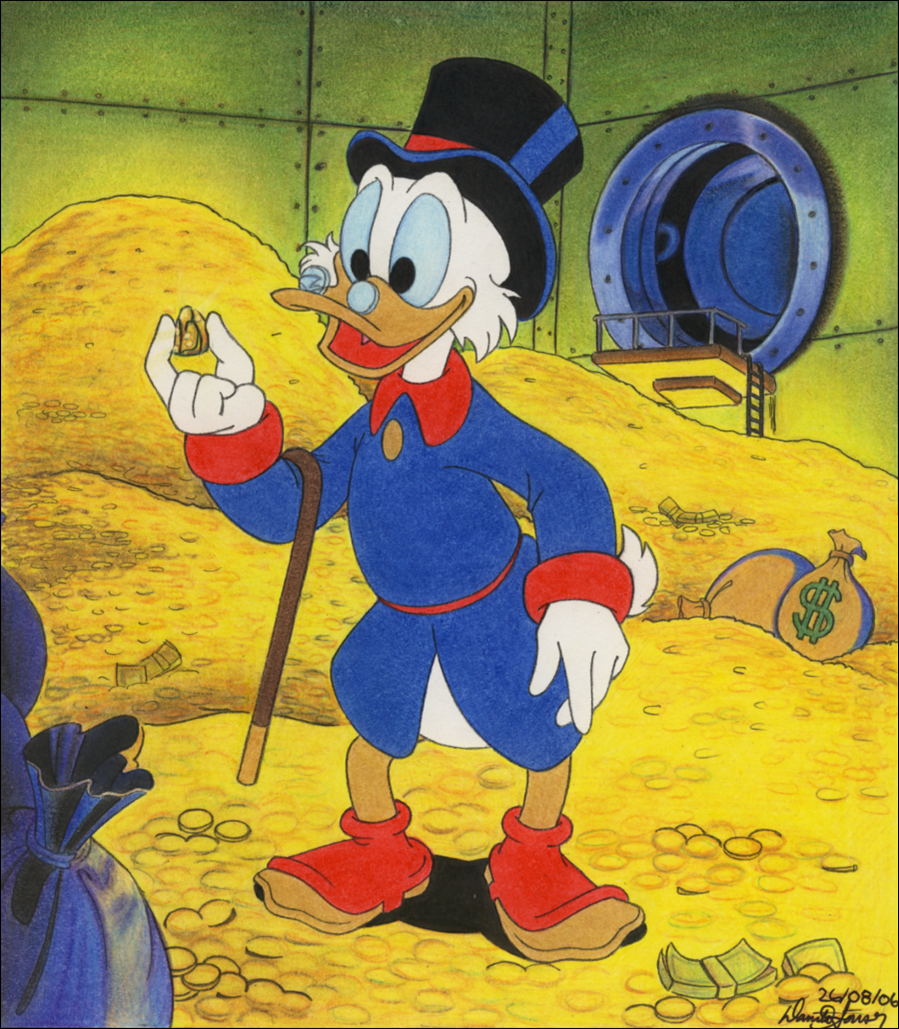
When you think about it, there's no social currency like money (or Duck Tales)
(Image courtesy of stormstrike.files.wordpress.com)
In this case, there are currencies that you and your organization exchange in any and all interactions. Of course, there's the reason most people work, which is money. You exchange your time and skills for a paycheck. That's one kind of currency exchange, but you also exchange your loyalty, positivity, good performance, and other things with your job in exchange for advancement, benefits, continued employment, and other things. You exchange your assets as currency for their assets, which you probably want. How you "pay out" your currency (if you do at all), has a profound impact on how you are perceived within the group and the organization as a whole.
This is a two-way street. If the organization is giving you what you perceive to be a lower value of exchange than you feel you deserve, you will likely give less to make the exchange feel more "equal" in your mind. Conversely, if the company sees that you are giving much more value to the company than the company perceives it is giving to you, then a promotion is probably not far off. This is essentially simple psychology that I have covered in previous blog posts, but it bears repeating, due to its profound importance to group dynamics. If your group isn't giving you what you believe you deserve, you won't give as much to your group or team, and that's not a sustainable relationship.
So, how do groups develop into a collaborative environment where these kinds of exchanges take place? Some dude back in 1965 named Bruce W. Tuckman developed a theory to help explain that very process, making him one of the pimpingest educational psychologists from that decade.

Pictured: The Pimpingest
(Image courtesy of i4learnlive2.co.uk)
He broke down his theory into five stages, starting with the formation of the group and ending with the eventual adjournment of the group. I will break down the steps one by one, and give real-life examples.
Step 1- Forming
Forming is the meet-and-greet stage, where nobody knows each other. There is some ambiguity as to who is in charge and what specific group roles are in this stage. During this stage, if there is a formal leader, he'd better step up and take charge or someone else will do it for him. A good example would be a group of motorcyclists. In my time riding my motorcycle all over northern California, I have found that it's super easy to get a group together, but difficult to give that group some direction. There are roles in riding groups that need to be fulfilled. The person in back sets the pace while the person in front watches for road hazards and alerts the group behind them. Usually, the ride organizer is automatically designated the formal leader, but if their leadership is insufficient, another rider (sometimes in mid-ride) can supersede them and take charge if they detect that the group is not enjoying themselves, which is the whole point of riding.
Step 2- Storming
Storming is where group members really feel out the situation with the leader and other members. this is a trying stage for the group, because this is where power blocs are born and politics play a big role. This is the stage where members test the policies of the leader, and where they begin to figure out where they fit into the group hierarchy. Imagine a company of new soldiers fresh out of boot camp joining with their battalion in an overseas deployment. Of course, they're the new guys. Imagine that boot camp is the forming stage. Now, they need to figure out how they fit into the scheme of things by testing their leader's policies and by forming groups. The book points out that this stage can be deadly because some people will try to make power grabs, leading to conflict.
Stage 3- Norming
According to the model, groups that make it this far did so because a member of the group other than the leader stepped up to call on group members to abandon power struggles and come together to work toward organizational goals. This is the part of the equation where team spirit begins to form, and people fall into their roles. Imagine a new online publication. The new team has already formed little groups that made plays for power gains in the office structure, but a member of the office has said that this can't work anymore. All members of the group sit down, hash out the problems, reaffirm their roles, and start to view the group as the vehicle for productivity, rather than a means to an end.
Stage 4- Performing
This is where task problems get solved. The group members won't be stepping on each other's toes in this stage. The group members cooperate with each other and help each other on tasks. The group's goals are now part of each member's commitment to the activity. Imagine an assembly line, where each member counts on other members to do their job correctly. Beyond the expectation, though, is TRUST that the other members WILL do their job correctly.
Stage 5- Adjourning
Unfortunately, the project is over, and the group must disband. A group that has made it to this stage will see it's members experiencing a sense of loss. Members will naturally miss the cohesiveness of the group and the people that they met. Often, there will be celebrations of success, or somber rituals of loss. Leaders will often give talks to the group about lessons learned, great work that was done in the group, and implore group members to prepare for their futures. In this case, think about a class of students at a college. They came into the school without any knowledge of each other, what the expectations were, or what their roles would be. Some of them made power plays in various extracurricular activities like sports and student government, but advisors and teachers were the primary supervisors that they reported to. The students form small groups and play for power (in this case, popularity is a big one). They then grow up a little, reaffirm their roles as students and not partying alcoholics, and everyone starts working together, sometimes forming study groups and other such things that help toward the common goal of graduation. In the end, they graduate, and the group dissolves.
We all love rewards
When you complete a task, you want to be legitimately rewarded, right? For most people, this takes the form of a fat paycheck that you sell you soul and time for. For others, they want the acceptance of their boss (fat chance). Still others simply take their reward from the virtue of their work.
The concept of rewards and positive reinforcement shares a two-way street with proper coaching and goal-setting. How can you be rewarded for not accomplishing a measurable outcome for your organization? This is where things can get hairy, because this dynamic is where that "corporate lemming" atmosphere can be inadvertently constructed.

NOT TO BE CONFUSED WITH THE BADASS OLDSCHOOL COMPUTER GAME "LEMMINGS"
(Image courtesy of Tonychor.com)
If you set a number of menial goals for your desk slaves to accomplish, they will simply jump through various organizational hoops toward the inevitable goal of suicide. These kinds of goals are called "performance outcome goals." You simply set some stupid bar like "sales numbers," or, "customer retention," and your employees become frustrated and disengaged, because they aren't being challenged in a meaningful or even enjoyable way. What works better are what Chapter 9 in our book calls, "learning goals." These goals encourage an employee to be creative, attack an interesting problem, and work toward developing new skills for future projects to achieve positive outcomes. If we get challenged in this way, we enjoy our jobs a lot more, and on average, get a lot less stabby with each other. Nobody likes explaining why they're stabby to their kids.

(Image courtesy of idiotpress.com)
There's a process to all this. This process is my focus today. An organization that wants a less stabtastic workforce wants to set good goals which the employees will at least tolerate.
First, you need to set goals. The book says that goals should be SMART (specific, measurable, attainable, results-oriented, and time bound). That's a good point. It's important to lay out goals in a way that makes things simple. Employees need to know what the goals are, what the metrics for success are, how they are attained, what the results of those goals are, and the time frame in which to accomplish them.
Second, an organization needs to sell these goals to the workforce. The best laid plans can quickly unravel without support. The book calls this "Promoting Goal Commitment." According to the book, it's important to do a number of things during this stage in the brain-washing. You need to explain why these goals have been set, what the goals are and how personal goals in the company come into play, get employees to develop personal action plans, get teams and units together to participate in goal-setting sessions, give employees control, and make sure there's an adequate reward. Oh yeah, and don't threaten them with these goals. They get stabby that way.
The last part of this whole equation is very important. There needs to be a system of feedback in place. People like knowing how they're doing. We get mid-term grades in college so we know if we're drinking too much (or not enough). The same can be said about the workplace (not the drinking part, the other part). Letting employees know how they are doing helps to foster a sense of community, and that management has an interest in an employee's contribution rather than the end result.
And now, a real-world example:
My father is a wine maker, and we have a number of goals, most of which involve doing specific things on specific dates within specified amounts of time. Wine is a temperamental beverage that can turn into garbage REALLY quickly. We need to pick grapes, stem and crush them, punch them down in large barrels, press them into juice, add yeast (and sometimes wood chips for flavor), and put the resulting juice into oak casks for two years to ferment. I am personally involved in every aspect of this process. We rack the wine on a consistent time table by moving the wine out of the barrel and cleaning the newly empty cask, then replacing the wine with topping wine from kegs and carboys. Mismanaging this step can leave you with wine full of sediment that ruins the overall product. I don't know how many of you out there are winos like us, but sediment in your wine makes it undrinkable. Imagine getting a mouthful of sand in a sip of beer. Same thing.
We set time-based goals with all those involved, making sure that everyone gives their input and gets on board with the process. We also make sure everyone knows what their job is and what their hourly goals are. We also have a system of rewards for good participation and effort in the form of free bottles of wine (it's like giving away $50 to everyone). My father and the other wine partner, Jay, keeps an eye on everyone, rewarding stellar effort with free wine and other rewards. We make sure that those who work hard toward their specific task get recognized by the group and duly rewarded.
When we're bottling wine every fall, this process of management by objectives is palpable in the air. We bottle about 80 cases of wine in one day. In our GARAGE. Yes, we make award-winning hooch in our garage.
All attendees get together and are given jobs, which rotate over the course of the day. We let everyone know that the primary goal is 80 cases over the course of the day (that's 960 bottles), but there are goals for individual jobs, like corking a certain number of bottles in an hour, or cleaning a certain amount of bottles in a batch. Those that perform well in their present task are rewarded with glasses of wine, and in some cases, bottles. We set goals for every task as well as organizational goals. When those goals are accomplished, we make sure everyone knows how well they are doing and how well others are doing. Goals change on the fly with changing conditions, and the managers (my father and Jay) constantly check on everyone to give them feedback on their performance. Because I've been involved in this process since birth, I can say that my one superpower is my ability to cork bottles. Sometimes, my buddies and I race each other to see who can cork the most bottles with flush corks in 5 minutes. I have never lost to anyone. Ever. I get rewarded with magnums of wine. I love October.

This is an actual picture of my garage. Yes, those are kegs filled with wine. Try a keg stand with one of those.
The concept of rewards and positive reinforcement shares a two-way street with proper coaching and goal-setting. How can you be rewarded for not accomplishing a measurable outcome for your organization? This is where things can get hairy, because this dynamic is where that "corporate lemming" atmosphere can be inadvertently constructed.
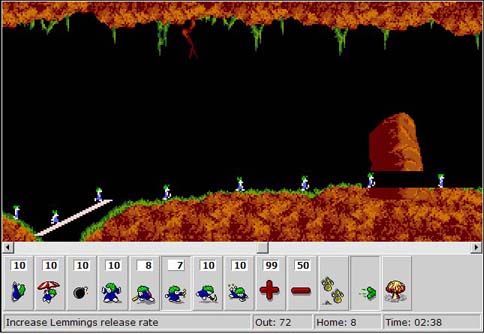
NOT TO BE CONFUSED WITH THE BADASS OLDSCHOOL COMPUTER GAME "LEMMINGS"
(Image courtesy of Tonychor.com)
If you set a number of menial goals for your desk slaves to accomplish, they will simply jump through various organizational hoops toward the inevitable goal of suicide. These kinds of goals are called "performance outcome goals." You simply set some stupid bar like "sales numbers," or, "customer retention," and your employees become frustrated and disengaged, because they aren't being challenged in a meaningful or even enjoyable way. What works better are what Chapter 9 in our book calls, "learning goals." These goals encourage an employee to be creative, attack an interesting problem, and work toward developing new skills for future projects to achieve positive outcomes. If we get challenged in this way, we enjoy our jobs a lot more, and on average, get a lot less stabby with each other. Nobody likes explaining why they're stabby to their kids.

(Image courtesy of idiotpress.com)
There's a process to all this. This process is my focus today. An organization that wants a less stabtastic workforce wants to set good goals which the employees will at least tolerate.
First, you need to set goals. The book says that goals should be SMART (specific, measurable, attainable, results-oriented, and time bound). That's a good point. It's important to lay out goals in a way that makes things simple. Employees need to know what the goals are, what the metrics for success are, how they are attained, what the results of those goals are, and the time frame in which to accomplish them.
Second, an organization needs to sell these goals to the workforce. The best laid plans can quickly unravel without support. The book calls this "Promoting Goal Commitment." According to the book, it's important to do a number of things during this stage in the brain-washing. You need to explain why these goals have been set, what the goals are and how personal goals in the company come into play, get employees to develop personal action plans, get teams and units together to participate in goal-setting sessions, give employees control, and make sure there's an adequate reward. Oh yeah, and don't threaten them with these goals. They get stabby that way.
The last part of this whole equation is very important. There needs to be a system of feedback in place. People like knowing how they're doing. We get mid-term grades in college so we know if we're drinking too much (or not enough). The same can be said about the workplace (not the drinking part, the other part). Letting employees know how they are doing helps to foster a sense of community, and that management has an interest in an employee's contribution rather than the end result.
And now, a real-world example:
My father is a wine maker, and we have a number of goals, most of which involve doing specific things on specific dates within specified amounts of time. Wine is a temperamental beverage that can turn into garbage REALLY quickly. We need to pick grapes, stem and crush them, punch them down in large barrels, press them into juice, add yeast (and sometimes wood chips for flavor), and put the resulting juice into oak casks for two years to ferment. I am personally involved in every aspect of this process. We rack the wine on a consistent time table by moving the wine out of the barrel and cleaning the newly empty cask, then replacing the wine with topping wine from kegs and carboys. Mismanaging this step can leave you with wine full of sediment that ruins the overall product. I don't know how many of you out there are winos like us, but sediment in your wine makes it undrinkable. Imagine getting a mouthful of sand in a sip of beer. Same thing.
We set time-based goals with all those involved, making sure that everyone gives their input and gets on board with the process. We also make sure everyone knows what their job is and what their hourly goals are. We also have a system of rewards for good participation and effort in the form of free bottles of wine (it's like giving away $50 to everyone). My father and the other wine partner, Jay, keeps an eye on everyone, rewarding stellar effort with free wine and other rewards. We make sure that those who work hard toward their specific task get recognized by the group and duly rewarded.
When we're bottling wine every fall, this process of management by objectives is palpable in the air. We bottle about 80 cases of wine in one day. In our GARAGE. Yes, we make award-winning hooch in our garage.
All attendees get together and are given jobs, which rotate over the course of the day. We let everyone know that the primary goal is 80 cases over the course of the day (that's 960 bottles), but there are goals for individual jobs, like corking a certain number of bottles in an hour, or cleaning a certain amount of bottles in a batch. Those that perform well in their present task are rewarded with glasses of wine, and in some cases, bottles. We set goals for every task as well as organizational goals. When those goals are accomplished, we make sure everyone knows how well they are doing and how well others are doing. Goals change on the fly with changing conditions, and the managers (my father and Jay) constantly check on everyone to give them feedback on their performance. Because I've been involved in this process since birth, I can say that my one superpower is my ability to cork bottles. Sometimes, my buddies and I race each other to see who can cork the most bottles with flush corks in 5 minutes. I have never lost to anyone. Ever. I get rewarded with magnums of wine. I love October.

This is an actual picture of my garage. Yes, those are kegs filled with wine. Try a keg stand with one of those.
"Cooperate and Graduate"
One of the topics discussed in Chapter 11 was how cooperation is encouraged within teams, but members still feel pressured to compete for higher positions or recognition within companies. Combating such competition between employees is certainly a predicament. From a young age, students learn to compete with others. Tests are designed sometimes so that the person with the highest grade automatically gets bumped up to 100% and then everyone else's grades revolve around that one. This means that students help eachother study for exams so that they all get around the same grade and all do well... or at least relatively well since those helping others in their study group understand the concepts risk their own grades because they spend unneccessary time helping their competition while they could be focusing on their own understanding and spending time perfecting their knowledge of the subject matter. If one students does well, while all the others perform poorly, then the majority's grades are not altered enough for them to pass. This is somewhat unfair, as it would indicated that the majority did not understand the concepts being taught and the teacher needs to focus on their needs, instead of categorizing them as 'failing'.
In the article I read, a former Kellogg student (monetarily supported by Kellog Corporation and then employeed by Kellogg) discussed how the students in the program worked. All were encouraged to be supportive of one another and cooperate well with eachother (in other words, follow the kellogg way of business so that they would be able to successfully integrate into the company upon graduation). However, there were only a few really good jobs available for them and so only a couple of students would be placed in their first choice job upon graduation. This led to competitiveness between them despite all the 'cooperation' talk. Competition is natural it seems and can not be avoided. However, there are ways around it. The author goes onto explain, "One of my close friends came to Kellogg with a mantra that he learned at West Point: Cooperate and graduate. It certainly shows. We spent literally dozens of hours helping each other prepare for our tests this quarter. Even though we were "aiding the competition," together I believe we were stronger students than we would've been as individuals." Even though it could damage one's chances of success, helping others in one's team makes everyone better people and leaves one feeling fulfilled.
Source:
Cornuke, Brandon. "Competition and Cooperation." BusinessWeek Online (2009): 5. Academic Search Complete. EBSCO. Web. 19 Mar. 2010.
In the article I read, a former Kellogg student (monetarily supported by Kellog Corporation and then employeed by Kellogg) discussed how the students in the program worked. All were encouraged to be supportive of one another and cooperate well with eachother (in other words, follow the kellogg way of business so that they would be able to successfully integrate into the company upon graduation). However, there were only a few really good jobs available for them and so only a couple of students would be placed in their first choice job upon graduation. This led to competitiveness between them despite all the 'cooperation' talk. Competition is natural it seems and can not be avoided. However, there are ways around it. The author goes onto explain, "One of my close friends came to Kellogg with a mantra that he learned at West Point: Cooperate and graduate. It certainly shows. We spent literally dozens of hours helping each other prepare for our tests this quarter. Even though we were "aiding the competition," together I believe we were stronger students than we would've been as individuals." Even though it could damage one's chances of success, helping others in one's team makes everyone better people and leaves one feeling fulfilled.
Source:
Cornuke, Brandon. "Competition and Cooperation." BusinessWeek Online (2009): 5. Academic Search Complete. EBSCO. Web. 19 Mar. 2010.
Friday, March 19, 2010
Work Teams ch 11
Different tasks require different types of teams to accomplish them. You wouldn’t want a board of office CEO’s pouring the cement foundation for a skyscraper, in the same sense you wouldn’t want making a team of ground workers making executive business decisions. Eric Sundstorm developed a typology of work teams which consists of 4 groups; advice, production, project and action. Each type of team is used for a basic purpose. The advice teams are created in order to broaden the information base for the managerial decisions; they also tend to have a low degree in technical specialization. The production teams are normally in charge of coordination and day-to-day operations. The third teams, project teams, are required to have creative problem solving skills and often specialized knowledge. Our final team is the action team, the workers who get their hands dirty and actually get the job done. This requires a high level of skill in a certain trade and an extreme level of competence. I like to think of these teams like a professional sports program. Where the advice, production and project teams consist off the head coach, assistant coaches and managers where the actual players take on the action role and win games.
I did some research on team effectiveness and found a lot of comparisons to how a sports team is run. One of the essential keys to team success is that everyone accepts their roles, no matter how big or small. Everyone must do their job to the best of their ability and do it with enthusiasm. Also trust and communication is an enormous part of a team’s success. This applies to any type of team, whether is be a group of executives, a soccer team, or a successful marriage.
http://www.time-management-guide.com/team-building.html
I did some research on team effectiveness and found a lot of comparisons to how a sports team is run. One of the essential keys to team success is that everyone accepts their roles, no matter how big or small. Everyone must do their job to the best of their ability and do it with enthusiasm. Also trust and communication is an enormous part of a team’s success. This applies to any type of team, whether is be a group of executives, a soccer team, or a successful marriage.
http://www.time-management-guide.com/team-building.html
Monday, March 15, 2010
Diversity
Chapter 2 is all about diversity and being to able to bring people from different cultures, backgrounds, and with different attitudes, personalities, characters, and values to work together in harmony and of course to work together effectively. The company benefits greatly from such things because it gets higher quality of work but it also allows their employees to work in stress free environment, and being able to get along with their co-workers will want to make employees want to go to work every morning and do their best everyday. Elijon Fitzgerald, Paul Spoonely, and Bronwyn Watson describe "Diversity Management" as, "a broad strand of organisational management literature that was developed as a means of helping organisations respond to the growing diversity apparent in contemporary labour markets. From the 1980s, discussions of diversity management focused on managing heterogeneity in the workforce in relation to demands for "affirmative action" and "equal employment opportunities" which were intended to increase numbers of workers from "minority" groups. Therefore many laws were made demanding that corporations and businesses gave equal treatment and equal opportunity, and such laws became getting passed in the 1960s by the United States. In this new millennium diversity has been seen as having a "marketing advantage" because of the different view points and all the diversity being a positive factor. But, some say that while it has great advantages in the market it might lead to overstaffing in managerial positions, or may lead to misunderstandings and some employees might feel used or exploited. Despite that countries across the globe are beginning to implement what they call "diversity dividends" which involves investing in diversity management today and a byproduct being future diversity dividends.
Kreitner, Robert. Organizational Behavior. 7th ed. New York: McGraw-Hill Irwin, 2007.
Watson, B., P. Spoonley, and E. Fitzgerald. "Managing Diversity: A Twenty-First Century Agenda. " New Zealand Journal of Employment Relations (Online) 34.2 (2009): 61-76. ABI/INFORM Global, ProQuest. Web. 15 Mar. 2010.
Group Sizing: Effective or Not?
What stood out to me in this chapter is the discussion about group sizing. As a manager, determining group size is essential to whatever objective you are trying to accomplish. A meta-analysis of eight studies showed: "as group size increased, group leaders tended to become more directive, and group member satisfaction tended to decline slightly" (Kreitner 285).
In a laboratory simulation of group behavior, Bottger and Yetton discovered that to maxamize decision quality, groups should be comprised of no more than 5 members. For objectives other than decision-making, larger groups may prove to be more useful. Although group size is ultimately up to the manager, it is recommended that odd numbered groups are more effective in decision making. Group size can determine the overall performance at hand.
I find this particularly true in the groups I have worked with in the past. The smaller, more intimate groups are usually more straight-forward. The larger groups are more useful in discussions because there are many opinions and perceptive offered.
Source: Yetton, Philip, and Preston Bottger. "The Relationships among Group Size, Member Ability, Social Decision Schemes, and Performance." Organizational Behavior & Human Performance 32.2 (1983): 145-159. Academic Search Complete. EBSCO. Web. 27 Feb. 2010.
In a laboratory simulation of group behavior, Bottger and Yetton discovered that to maxamize decision quality, groups should be comprised of no more than 5 members. For objectives other than decision-making, larger groups may prove to be more useful. Although group size is ultimately up to the manager, it is recommended that odd numbered groups are more effective in decision making. Group size can determine the overall performance at hand.
I find this particularly true in the groups I have worked with in the past. The smaller, more intimate groups are usually more straight-forward. The larger groups are more useful in discussions because there are many opinions and perceptive offered.
Source: Yetton, Philip, and Preston Bottger. "The Relationships among Group Size, Member Ability, Social Decision Schemes, and Performance." Organizational Behavior & Human Performance 32.2 (1983): 145-159. Academic Search Complete. EBSCO. Web. 27 Feb. 2010.
Role Overload
Role overload is something that we, as students, are very familiar with. Between school, our families, our friends, and sometimes even work, there are times that 24 hours a day is not enough. In my own experience, I agree with what the book said about role overload. The book said that the more things we do per day, the more stressed we get, and the personal efficacy lessens. Being a student, an eldest sibling in my family, trying to have a social life, and trying to find work, I found out that there are times that I find myself lacking in some roles. For example, to be able to relax and spend time with friends, I have to give up doing my homework at an early time. When this happens, I end up falling asleep or just putting off homework for the next day.
I always thought though that role overload would be one of the major stressors in a person’s life. I was shocked after coming across this study. According to a study named “Role Overload, Role Conflict, and Stress: Addressing Consequences of Multiple Role Demands” by Shelley Coverman, though role overload does play a role in giving a person stress, it was not something major. “The weakest effects observed in the model involved role overload. These effects tend to be small and inconsistent, suggesting that time expenditures do not strongly influence stress levels.” (p.978) Interestingly enough, things like marriage problems or employment problems ranked higher than the overload.
Source:
Coverman, S. (2989). Role Overload, Role Conflict, and Stress: Addressing Consequences of Mutiple Role Demands. University of North Carolina Press , pp.965-982.
I always thought though that role overload would be one of the major stressors in a person’s life. I was shocked after coming across this study. According to a study named “Role Overload, Role Conflict, and Stress: Addressing Consequences of Multiple Role Demands” by Shelley Coverman, though role overload does play a role in giving a person stress, it was not something major. “The weakest effects observed in the model involved role overload. These effects tend to be small and inconsistent, suggesting that time expenditures do not strongly influence stress levels.” (p.978) Interestingly enough, things like marriage problems or employment problems ranked higher than the overload.
Source:
Coverman, S. (2989). Role Overload, Role Conflict, and Stress: Addressing Consequences of Mutiple Role Demands. University of North Carolina Press , pp.965-982.
Chapter 10: Social Networking and Social Loafing
In this chapter, social factors of working with other people are discussed. In today's business world, working with others is inevitable, and having social connections is vital in creating success. Due to competition, applicants and employees must engage in social networking. Social networking is an interdependence between individuals who share common interests, goals, etc. Through social networking, individuals can gain recognition and expand his or her own name in order to reach a job or create a connection. Today, it's harder to apply for a job due to the competition, and through social networking, your application can be put on the top of the pile in order to get recognized faster. There are many ways to network with people; however, social networking should not be a one way relationship that helps a person get a job. The individual must maintain a relationship with others in order to sustain a meaningful, helpful connection.
On the other hand, another social aspect discussed was social loafing. Social loafing is exhibited when a person chooses to put less effort as the group size increases. It is definitely important to make sure group work is split among members, and the tasks given must be covered by each member having no one be passive. Group work is always present in business environments, and it is important to work together in order to increase production and increase success. Having a member put forth less effort can bring a group down due to having to carry the less-effective member's load that was not met. No individual should be granted less work than another in order to effectively create good group work.
I feel that social loafing does bring a group down from experience; it creates more work on those who already are working enough. I work retail, and if a fellow associate doesn't follow instructions or take care of tasks correctly, at the end of the day, those who close the store are left with correcting the mistakes. It's important to make sure to encourage individuals to work effectively and equally. It is also important to create connections with those you work with or who you'd like to work with in order to expand your name and create helpful relationships.
On the other hand, another social aspect discussed was social loafing. Social loafing is exhibited when a person chooses to put less effort as the group size increases. It is definitely important to make sure group work is split among members, and the tasks given must be covered by each member having no one be passive. Group work is always present in business environments, and it is important to work together in order to increase production and increase success. Having a member put forth less effort can bring a group down due to having to carry the less-effective member's load that was not met. No individual should be granted less work than another in order to effectively create good group work.
I feel that social loafing does bring a group down from experience; it creates more work on those who already are working enough. I work retail, and if a fellow associate doesn't follow instructions or take care of tasks correctly, at the end of the day, those who close the store are left with correcting the mistakes. It's important to make sure to encourage individuals to work effectively and equally. It is also important to create connections with those you work with or who you'd like to work with in order to expand your name and create helpful relationships.
Sunday, March 14, 2010
Chapter 9 - Why isn't extrinsic motivation effective?
As we learned in class, intrinsic motivational proves to be more effective than extrinsic motivation. But what I left thinking was why. The majority of companies use extrinsic motivation with the exception of the overused example that is Google. But still, millions of employees main drive to work is reward. I realize that extrinsic motivation is effective during mundane, robot-like tasks, but it seems as though those aren't the only jobs that extrinsic motivation is used for. My question now is this; why doesn't extrinsic motivation work? Bonuses, incentives, and even a threat to ones job seems to all be an effective way to ensure superior performance.
To find out why, I turn to an article by Alfie Kohn. I found my answer in one simple sentence: "If a reward — money, awards, praise, or winning a contest — comes to be seen as the reason one is engaging in an activity, that activity will be viewed as less enjoyable in its own right." It all seems to make perfect sense now. Perhaps this is why I always hear people saying something along the lines of "Don't let your favorite thing to do become your job, or it won't be fun anymore." If you love traveling yet your job is to continuously travel for work day in and day out, it would probably hinder your enjoyment for it.
Perhaps that is why extrinsic motivation isn't so effective. People just don't get enjoyment out of it. Even the power of money as a reward doesn't counter balance out the lack of enjoyment. Enjoyment seems to always have the upper hand when it comes to productivity.
Another question in life answered.
Kohn, Alfie. "Studies Find Reward Often No Motivator." (1987): 1. Web. 14 Mar 2010.
To find out why, I turn to an article by Alfie Kohn. I found my answer in one simple sentence: "If a reward — money, awards, praise, or winning a contest — comes to be seen as the reason one is engaging in an activity, that activity will be viewed as less enjoyable in its own right." It all seems to make perfect sense now. Perhaps this is why I always hear people saying something along the lines of "Don't let your favorite thing to do become your job, or it won't be fun anymore." If you love traveling yet your job is to continuously travel for work day in and day out, it would probably hinder your enjoyment for it.
Perhaps that is why extrinsic motivation isn't so effective. People just don't get enjoyment out of it. Even the power of money as a reward doesn't counter balance out the lack of enjoyment. Enjoyment seems to always have the upper hand when it comes to productivity.
Another question in life answered.
Kohn, Alfie. "Studies Find Reward Often No Motivator." (1987): 1. Web. 14 Mar 2010.
Chapter 10 - Going against the group
Chapter 10 offered a good summary of team dynamics but what was left lingering in my mind was the real world real people example. It talked about how Ken Heebner, a very successful investor, and an experience he had in college. It detailed a psychological experiment that he participated in and the end result was that he was the only person, out of everyone surveyed, that showed "showed no evidence that other people's opinion had any effect whatsoever on what he thought."
In my opinion, that is a very admirable trait. To find someone in today's time that possess a similar quality, would be quite difficult. In my experience, the majority of people I know, will alter their initial impression or thoughts based on the social situation. Even in our class during the ethics test, this was in play. The ethics test was about hypothetical situations that we were to place themselves in, and to raise our hand when the action that we were most likely to agree with was read off. I noticed most of us would glance around looking for allies in thought during this process, before raising their own hand. And other times, people would not raise their hand for an answer, simply because no one else did. This is a core example of letting our peers affect our opinion. Whether this is beneficial or disadvantageous is debatable.
You'll hear in a lot of celebrity interviews, "I don't really care what other people think." I can't help by think that this is a trait that you must possess in order to stand out, which can ultimately affect one's business career, whether in a positive or negative way.
Burger, John. "The mad genius of mutual funds." 06 Jun 2006: 2. Web. 14 Mar 2010..
In my opinion, that is a very admirable trait. To find someone in today's time that possess a similar quality, would be quite difficult. In my experience, the majority of people I know, will alter their initial impression or thoughts based on the social situation. Even in our class during the ethics test, this was in play. The ethics test was about hypothetical situations that we were to place themselves in, and to raise our hand when the action that we were most likely to agree with was read off. I noticed most of us would glance around looking for allies in thought during this process, before raising their own hand. And other times, people would not raise their hand for an answer, simply because no one else did. This is a core example of letting our peers affect our opinion. Whether this is beneficial or disadvantageous is debatable.
You'll hear in a lot of celebrity interviews, "I don't really care what other people think." I can't help by think that this is a trait that you must possess in order to stand out, which can ultimately affect one's business career, whether in a positive or negative way.
Burger, John. "The mad genius of mutual funds." 06 Jun 2006: 2. Web. 14 Mar 2010.
Five Stages
The psychologist Bruce W. Tuckman came u with a four stage model for group development process. Ten years later Tuckman and a doctoral student added a fifth stage. The stages are forming, storming, norming, performing, and adjourning. Today most people in the OB field follow this model as if it were a fact, however, it is still just a model. The different stages are not of the duration or intensity. Stage one, forming, is when people are still uncertain about their roles in the group and what to expect from the group. people usually hold back and don't give all their ideas or act completely themselves. Eventually, someone will step into the leadership role and get things started. Stage tow, storming, is when people test the leader and see what will be tolerable and will not be tolerable. Subgroups usually form and little rebellions take place in this stage. Most groups stall in this stage because the little rebellions become big rebellions. Stage three, norming, is when the group as a whole sits down and resolves any problems it might be having. It takes someone besides the leader to step up to begin this stage. This is the stage where group cohesiveness is gained. Stage four, performing, is when the group is working its best. people know their roles in the group and thanks to stage 2 there is now open communication among members. The final stage is adjourning. This is where the work is done and the members go back to being independent. It is also the stage that the leader tells everyone what lessons were learned while working together.
I also did some more research and found a site that went into more detail about the five stages and assesses them. It also talks of how Tuckman came u with the model.
Smith, M. K. (2005) 'Bruce W. Tuckman - forming, storming, norming and performing in groups, the encyclopaedia of informal education, www.infed.org/thinkers/tuckman.htm.
I also did some more research and found a site that went into more detail about the five stages and assesses them. It also talks of how Tuckman came u with the model.
Smith, M. K. (2005) 'Bruce W. Tuckman - forming, storming, norming and performing in groups, the encyclopaedia of informal education, www.infed.org/thinkers/tuckman.htm.
Friday, March 12, 2010
Social Loafing
Social loafing is a factor that is apparent in many group projects. Social loafing is when an individual chooses to put forth less effort as the group size increases. Social loafing can affect group effectiveness and synergy. Laboratory studies show theories of why social loafing is present in group environments. The three theories is that “the task is perceived to be unimportant, simple, or not interesting, group members thought their individual output was not identifiable, and that group members expected their coworkers to loaf.” Management techniques can avoid social loafing to be present within a group. In addition, the stepladder technique can rid social loafing by increasing each individual’s personal effort and their accountability.
In the article, “Social Loafing” provides additional ways to prevent social loafing in groups. In addition to increasing accountability, peer evaluation or writing a team contract will allow team members to put forth effort. It is important to identify who will implement these measures for the group. “A functional manager will not have sufficient authority due to the fact that team members can be from different departments.” Using a project manager or team leader will allow this approach to be efficient because they will have basic knowledge of organizational behavior. What I learned from this article is that the key to avoid social loafing is not to develop a sense of community in the group, but to define individual tasks.
Kreitner, Robert. Organizational Behavior. 9th ed. Vol. 1. New York: McGraw-Hill Irwin, 2010.
Organizational Behavior and Leadership E-zine. 2 Sept. 2009. Web. 12 Mar. 2010.
In the article, “Social Loafing” provides additional ways to prevent social loafing in groups. In addition to increasing accountability, peer evaluation or writing a team contract will allow team members to put forth effort. It is important to identify who will implement these measures for the group. “A functional manager will not have sufficient authority due to the fact that team members can be from different departments.” Using a project manager or team leader will allow this approach to be efficient because they will have basic knowledge of organizational behavior. What I learned from this article is that the key to avoid social loafing is not to develop a sense of community in the group, but to define individual tasks.
Kreitner, Robert. Organizational Behavior. 9th ed. Vol. 1. New York: McGraw-Hill Irwin, 2010.
Organizational Behavior and Leadership E-zine. 2 Sept. 2009. Web. 12 Mar. 2010.
Thursday, March 11, 2010
Social Networking Too Social?
Almost everyone nowadays participates in Social Networking, whether it be through facebook, myspace, or even Blogger. In the past people would confide in their friends their true feelings about their jobs or the events of their days and were confident that their friends would keep their secrets or stories to themselves. There was such a thing as after-hours, freedom from the workplace. However, nowadays when you post your thoughts on your site, expecting that only your friends will see them, sometimes word spreads and oftentimes has negative consequences. Many people have been fired due to information that was gleaned from their choice networking site. People can no longer take 'sick days' in order to get some necessary housework done or go on a field-trip with their kid.. or at least they can, but they cannot spread the word about their actions to their friends. Everything that is posted must be carefully considered. Some complain that the negative career effects of social networking sites are a violation of their freedom of speech. They posted or commented something after office-hours, so what they say or do should have no effect on their career in a company. People have been fired for simply stating that they were bored at work that day. I find this ridiculous.
As long as people do not write slander about their company or the people they work with, they should be able to post such feelings freely. If managers were smart, they would even encourage such action because they could use the information to better their work environment and organization. If their employees are bored or feel they have no purpose, then it is the manager's duty to shake things up a bit and give purpose to their work so that they can feel pride in what they do and be motivated to do what they do well. In this way, the employees are content and business prospers. Social networking should be viewed as just that, social, not professional. Social networking can be a good part of the feedback loop if freedom of speech is encouraged. Companies need to realize that their employee's lives do not always revolve around their work. Not even the CEOs of companies are purely motivated to live because of their job. They have other interests as well. Such interests need to be taken into account and encouraged so that people will be able to function to the best of their ability everyday at work. When people are satisfied with other areas of their life, then their outlook is much more positive and their energy level increases and they are able to be top company performers.
Source:
Breslin, Tom. "When social networking enters the workplace." Massachusetts Nurse 80.8 (2009): 14. Academic Search Complete. EBSCO. Web. 11 Mar. 2010
As long as people do not write slander about their company or the people they work with, they should be able to post such feelings freely. If managers were smart, they would even encourage such action because they could use the information to better their work environment and organization. If their employees are bored or feel they have no purpose, then it is the manager's duty to shake things up a bit and give purpose to their work so that they can feel pride in what they do and be motivated to do what they do well. In this way, the employees are content and business prospers. Social networking should be viewed as just that, social, not professional. Social networking can be a good part of the feedback loop if freedom of speech is encouraged. Companies need to realize that their employee's lives do not always revolve around their work. Not even the CEOs of companies are purely motivated to live because of their job. They have other interests as well. Such interests need to be taken into account and encouraged so that people will be able to function to the best of their ability everyday at work. When people are satisfied with other areas of their life, then their outlook is much more positive and their energy level increases and they are able to be top company performers.
Source:
Breslin, Tom. "When social networking enters the workplace." Massachusetts Nurse 80.8 (2009): 14. Academic Search Complete. EBSCO. Web. 11 Mar. 2010
Monday, March 8, 2010
Chapter 10: Tuckman's Theory of Group Development
In Chapter 10 the part that resonated with me the most is Tuckman's Theory of Group Development, which is a non-sequential model that groups use when they come together and begin to work as a team. There are five main steps he speaks about which are forming, storming, norming, performing, and adjourning. These five steps seem to be essential factors in helping a team build trust and a strong relationship among each other. As a result, it becomes easier for groups to accomplish tasks and be productive in the assignments they are given.
An example is an article written by Despina Potari, which is methodologically based, and is addressing the study of mathematics group teaching in a middle school setting. It goes about using teaching activities and using in order to go about using team work in which classroom teaching is situated. Theoretical and methodological approaches are illustrated through episodes from a group study of the mathematics teaching and learning in a Year-10 class in a UK secondary school where students were considered as “lower achievers” in their year group. It show how a number of questions about mathematics teaching and learning through group work among the students helps them excel in their school work. In addition, this framework provided a way to address complexity in the activity of teaching and its development based on recognition of their work in teams in mathematics teaching–learning.
source: Jaworski, Barbara, and Despina Potari. "Bridging the macro- and micro-divide: using an activity theory model to capture sociocultural complexity in mathematics teaching and its development." Educational Studies in Mathematics 72.2 (2009): 219-236. Academic Search Complete. EBSCO. Web. 8 Mar. 2010.
An example is an article written by Despina Potari, which is methodologically based, and is addressing the study of mathematics group teaching in a middle school setting. It goes about using teaching activities and using in order to go about using team work in which classroom teaching is situated. Theoretical and methodological approaches are illustrated through episodes from a group study of the mathematics teaching and learning in a Year-10 class in a UK secondary school where students were considered as “lower achievers” in their year group. It show how a number of questions about mathematics teaching and learning through group work among the students helps them excel in their school work. In addition, this framework provided a way to address complexity in the activity of teaching and its development based on recognition of their work in teams in mathematics teaching–learning.
source: Jaworski, Barbara, and Despina Potari. "Bridging the macro- and micro-divide: using an activity theory model to capture sociocultural complexity in mathematics teaching and its development." Educational Studies in Mathematics 72.2 (2009): 219-236. Academic Search Complete. EBSCO. Web. 8 Mar. 2010.
Saturday, March 6, 2010
Tuckman's Theory of Group Development
Chapter 10 discusses Tuckman's 5 stage theory of group development. The five steps are forming, storming, norming, performing, and adjourning. Each step is critically important in ice-breaking, integrating opinions, group cohesiveness, solving task problems, and celebrating a job well done. If all the group processes do not occur, the group may not be fully mature or effective, resulting in decreased productivity and results. Each individual member also goes through this development process, overcoming various personal issues as related to the entire group. This might include realignment of values with the group's, increasing motivation, or overcoming job challenges.
Tuckman's theory as discussed in Exploring Leadership: For College students who want to make a difference," is described in terms of the relationship leadership model. The Relational leadership model defines leadership as dependent on the relationships we have with others. The book displays aspects of the model that might help the group successfully deal with each stage of its development. For example, in forming the group leaders must "be inclusive and empowering. Make sure all the shareholders and stakeholders are involved. Seek diverse members to bring talent to the group. Model the processes of inclusion and shared leadership. Identify common purposes and targets of change" (Komives, 221). Although the OB text goes into leadership in later chapters, Exploring Leadership provides insight into group development's and Tuckman's relationship with one style of leadership.
Komives, Susan R. Et al. Exploring Leadership. John Wiley and Sons, Inc. San Francisco: 2007.
Kreitner, Robert. Organizational Behavior. 9th ed. Vol. 1. New York: McGraw-Hill Irwin, 2010.
Friday, March 5, 2010
Chapter 10
In this chapter, the book talks about roles and the different sections. These sections include: role episodes, role overload, role conflict, and role ambiguity. The section that stood out the most to me is role overload. Role overload seems to be something that a lot of students seem to be feeling these days, especially college students. Role overload is defined as ‘the total sum of what role senders expect of the focal person far exceeds what he or she is able to do.’ I’ve noticed that this tends to happen a lot to us, especially during midterms and finals week. We, as students, are overwhelmed with having to study, hold a job, and commit to a club or sports team. The expected roles of us to be students, employees, and active participants in sports or a club sometimes exceed our limits of handling those responsibilities. On top of those roles, we also have a social life role to fill as well. In order to overcome or avoid role overload, students should better manage their time by weighing which roles are more important for that particular situation and time. It sounds easier said than done, but things like this take lots of practice and mistakes in order to manage it.
On a website titled, Problems at the Work-Life Interface: Role Overload, it gathered information about Canadians feelings of role overload in 1991 and 2001. In 1991, 42% of Canadians reported to feeling role overload. However, in 2001, that percentage jumped to 56%, showing a 6% increase. The sources of role overload were divided into two categories: emotional/physical fatigue, and feeling time-crunched. Emotional/physical fatigue creates role overload because the people are trying to hard to balance all the roles in their life. Feeling time-crunched occurs because people feel that they have too many things to do in such a short amount of time. This website pointed out an important idea because I’ve noticed that our society and culture has turned into one where time is so important that it feels like we never have enough of it. Because we feel like we don’t have enough of time, we spend more time working than resting which leads to emotional/physical fatigue. A lot of people want to get out of this time-crunched feeling but they’re too busy keeping up with everyone else. If this cycle were to change, it would have to start with individuals.
Works Cited
Problems at the Work-Life Interface: Role Overload. 24 December 2004. 5 March 2010 (http://www.hrsdc.gc.ca/eng/lp/spila/wlb/vcswlb/25role_overload.shtml).
On a website titled, Problems at the Work-Life Interface: Role Overload, it gathered information about Canadians feelings of role overload in 1991 and 2001. In 1991, 42% of Canadians reported to feeling role overload. However, in 2001, that percentage jumped to 56%, showing a 6% increase. The sources of role overload were divided into two categories: emotional/physical fatigue, and feeling time-crunched. Emotional/physical fatigue creates role overload because the people are trying to hard to balance all the roles in their life. Feeling time-crunched occurs because people feel that they have too many things to do in such a short amount of time. This website pointed out an important idea because I’ve noticed that our society and culture has turned into one where time is so important that it feels like we never have enough of it. Because we feel like we don’t have enough of time, we spend more time working than resting which leads to emotional/physical fatigue. A lot of people want to get out of this time-crunched feeling but they’re too busy keeping up with everyone else. If this cycle were to change, it would have to start with individuals.
Works Cited
Problems at the Work-Life Interface: Role Overload. 24 December 2004. 5 March 2010 (http://www.hrsdc.gc.ca/eng/lp/spila/wlb/vcswlb/25role_overload.shtml).
Monday, March 1, 2010
Goals
Although many people did their post on goals, I feel that it is important enough to elaborate further on. Goals are what drive people to do better and keep reaching. Many people think of goal-setting as an effective way to reach their aspirations and stay on track. Some people however, just think of goals as the destination you are driving to and not also the white lines guiding you there.
When setting a goal, it is best to make sure that they are actually obtainable. Although when setting an unobtainable goal, you may still strive to reach it, thus keeping you one track to bettering yourself in one way or another. The most effective way to succeed and reach your goals is to first set the goal, then it is important to plan out how you can reach your goal and to follow the steps laid out in the plan.
In the reading, there were two types of goal-setting discussed, these were performance-outcome goals, and learning goals. After some further research, I have come to the conclusion that both methods were good, and neither was a better method than the other. I do think that its important to use both though when making goals in the workplace.
Source: "Why Are Goals Important?." ToolKit.com. N.p., Jan. 2010. Web. 28 Feb. 2010.
Chapter 9: Goals
In chapter 9, goal setting is discussed, and two methods of goal setting is introduced: performance outcome goals and learning goals. Goal setting is definitely important in the work world due to meeting deadlines, getting assignments/ projects done, and improving/ moving up on your position. Goal setting helps workers focus on certain tasks and subjects making it easier to achieve and work harder; goal setting helps prioritize. When workers have a goal to reach, it gives them motivation to work towards that goal, and workers tend to work more persistent and harder. Also, through goals, workers may learn to apply knowledge and learn new aspects and work factors. Goal setting is seen as a motivational technique.
There are two methods of goal setting like I mentioned. I researched and found an article arguing that performing outcome goals are better than learning goals in the work world. In the article, it says that learning goals mainly focus on the individual and their use of knowledge and gaining new information and techniques. The article argues that in the work world, if someone is focused on learning goals, the company may deal with lagging of that employee due to their need for learning. On the other hand, the article then says that without learning goals, people involved in performance outcome goals may disregard the learning aspects involved in the job activity.
I think that in order to work efficiently and meaningfully, one must definitely set goals for themselves. Through goal setting, workers must learn in the process in order to reach their goals. I don't think one method is better than the other, and I do think that the methods must intertwine in order to work hard and grow in the work world.
source: http://www.iveybusinessjournal.com/view_article.asp?intArticle_ID=634
There are two methods of goal setting like I mentioned. I researched and found an article arguing that performing outcome goals are better than learning goals in the work world. In the article, it says that learning goals mainly focus on the individual and their use of knowledge and gaining new information and techniques. The article argues that in the work world, if someone is focused on learning goals, the company may deal with lagging of that employee due to their need for learning. On the other hand, the article then says that without learning goals, people involved in performance outcome goals may disregard the learning aspects involved in the job activity.
I think that in order to work efficiently and meaningfully, one must definitely set goals for themselves. Through goal setting, workers must learn in the process in order to reach their goals. I don't think one method is better than the other, and I do think that the methods must intertwine in order to work hard and grow in the work world.
source: http://www.iveybusinessjournal.com/view_article.asp?intArticle_ID=634
Chapter 9: Thorndike's Law of Effect-Favorable Consequences are Repeated
In chapter nine the concept that resonated with me the most was Thorndike’s Law of Effect. In the early 1900’s a psychologist named Edward E. Thorndike created an experiment in his psychology laboratory. The authors of the book which are Kreitner and Knicki explained how Throndiek observed that a cat behaved wildly when placed inside a box (Kreitner and Knicki 263). This box had a secret trip lever which the cat accidently found out about; when placed back into the box the cat would go directly to the lever (Kreitner and Knicki 263). As a result, Thorndike came up with a law which says “behavior with favorable consequences tens to be repeated, while behavior with unfavorable consequences tends to disappear. In many cases this theory is correct because many of us don’t go complete a task unless there is something in it for us. We do not accomplish things unless we are sure we will encounter positive or expected results.
In the TED video, Dan Pink talks about the motivation and excitement that occurs within an individual when they are given rewards. The incentives that individuals are presented with are what move him or her, including a large group of individuals such as companies. An example is an article by Peter F. Eder which talks about the new competitive strategy of businesses to help increase their profit. It explains how companies are using sustainable wealth, “going green”, to help increase their sales. With this strategy companies are able to manipulate consumers into buying their products. As a result, many more companies are beginning to use this method.
Source: Eder, Peter F. "Profit Power Economics: A New Competitive Strategy for Creating Sustainable Wealth." World Future Review 1.5 (2009): 91-93. Academic Search Complete. EBSCO. Web. 1 Mar. 2010.
In the TED video, Dan Pink talks about the motivation and excitement that occurs within an individual when they are given rewards. The incentives that individuals are presented with are what move him or her, including a large group of individuals such as companies. An example is an article by Peter F. Eder which talks about the new competitive strategy of businesses to help increase their profit. It explains how companies are using sustainable wealth, “going green”, to help increase their sales. With this strategy companies are able to manipulate consumers into buying their products. As a result, many more companies are beginning to use this method.
Source: Eder, Peter F. "Profit Power Economics: A New Competitive Strategy for Creating Sustainable Wealth." World Future Review 1.5 (2009): 91-93. Academic Search Complete. EBSCO. Web. 1 Mar. 2010.
Subscribe to:
Posts (Atom)